
Table of Contents
What Are AI Voice Agents? The Future of Real-Time Conversations
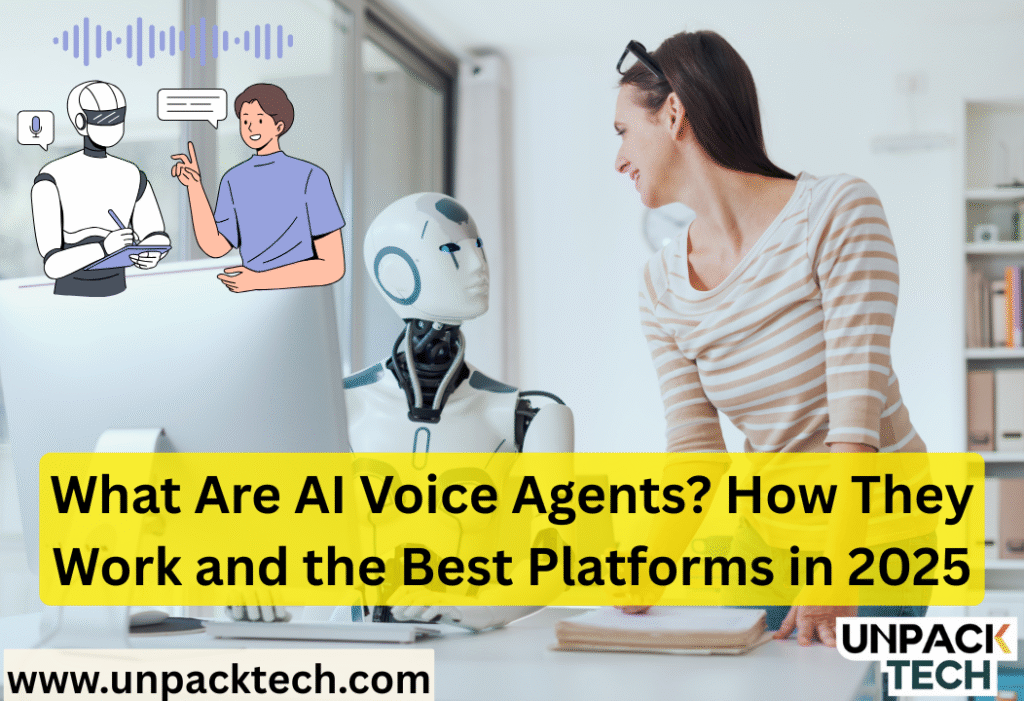
AI voice agents are transforming the way businesses and individuals interact over phone and internet-based communication channels. Unlike traditional interactive voice response (IVR) systems that relied on rigid menus and button inputs, modern AI voice agents engage in natural, two-way conversations. They can understand free-form speech, handle interruptions, and even integrate with external tools like CRMs, payment systems, or schedulers to complete tasks end-to-end.
From booking appointments and processing payments to providing 24/7 customer support, AI voice agents are no longer just futuristic concepts—they are practical, production-ready systems being deployed across industries today.
The Core Technology Pipeline of Voice Agents
AI voice agents work by combining several advanced technologies into a real-time conversational pipeline. Let’s break it down:
1. Automatic Speech Recognition (ASR)
The ASR system transcribes spoken input into text in real-time. For natural conversations, latency must remain within 200–300 ms, enabling smooth turn-taking. Modern ASR tools now achieve near-human transcription accuracy, even in noisy environments.
2. Language Understanding & Planning
Powered by large language models (LLMs) and retrieval tools, this layer interprets the user’s intent, maintains context across turns, and determines the next action. Depending on the request, it may call external APIs, databases, or orchestration systems to fetch relevant information or perform multi-step tasks.
3. Text-to-Speech (TTS)
Once a response is generated, TTS systems convert text back into natural-sounding speech. Cutting-edge systems deliver the first audio token within ~250 ms, support multiple tones and emotional expressions, and allow barge-in (where the user interrupts while the AI is still speaking).
4. Transport & Telephony Integration
This component connects the AI agent to communication networks, such as PSTN, SIP, or WebRTC. It also integrates with contact center systems and provides DTMF (keypad tone) fallback for compliance or accessibility requirements.
Why Voice Agents Are Taking Off Now
Several breakthroughs have pushed AI voice agents into mainstream adoption:
- High-accuracy ASR & TTS: AI now provides near-human speech transcription and natural, expressive voices.
- Low-latency LLMs: Modern AI models can plan and generate responses in sub-second timeframes.
- Better turn-taking: Advances in endpoint detection make conversations feel less robotic and more human-like.
These improvements mean businesses can rely on voice agents for real-world tasks such as after-hours support, call deflection, customer onboarding, and workflow automation.
Voice Agents vs. Voice Assistants: What’s the Difference?
Although the terms are sometimes used interchangeably, there’s a clear distinction between voice assistants (like Alexa, Siri, or Google Assistant) and AI voice agents:
- Voice Assistants: Primarily answer questions or provide information (e.g., “What’s the weather today?”).
- Voice Agents: Designed to take action and execute workflows (e.g., rescheduling an appointment, updating a CRM, or processing a payment).
In short, assistants inform, while agents perform.
Top 9 AI Voice Agent Platforms in 2025
If you’re considering building or deploying a voice agent, here are some of the leading platforms available today:
- OpenAI Voice Agents – Real-time multimodal API for context-aware, low-latency AI conversations.
- Google Dialogflow CX – Advanced dialog management with deep Google Cloud and telephony integration.
- Microsoft Copilot Studio – No-code/low-code builder for Dynamics, CRM, and Microsoft 365 workflows.
- Amazon Lex – AWS-native conversational AI with seamless integration into Amazon Connect and other cloud tools.
- Deepgram Voice AI Platform – Enterprise-grade platform for speech-to-text, TTS, and orchestration.
- Voiceflow – Collaborative design platform for voice, chat, and omnichannel conversational agents.
- Vapi – Developer-friendly API with strong configurability for testing and deploying AI voice agents.
- Retell AI – Comprehensive solution for designing, testing, and running call center AI agents.
- VoiceSpin – Contact center-focused voice AI with inbound/outbound bots, CRM integrations, and omnichannel messaging.
Final Thoughts
AI voice agents are rapidly becoming a core component of digital transformation strategies. Unlike legacy IVRs, today’s agents combine ASR, LLM-powered reasoning, and advanced TTS to carry out real tasks rather than just routing calls.
When choosing a platform, businesses should evaluate:
- Integration capabilities (CRM, APIs, telephony)
- Latency performance (sub-second response times for natural flow)
- Operational features (compliance, analytics, monitoring, and testing)
As adoption continues to grow, companies that implement AI voice agents early will gain a competitive edge in customer experience, efficiency, and scalability.
Ready to Explore AI Voice Agents?
If you’re excited about the future of conversational AI and how it can transform industries, keep following Unpack Tech for the latest reviews, insights, and product breakdowns. Have you tried integrating a voice agent into your business workflow yet? Share your thoughts in the comments below!